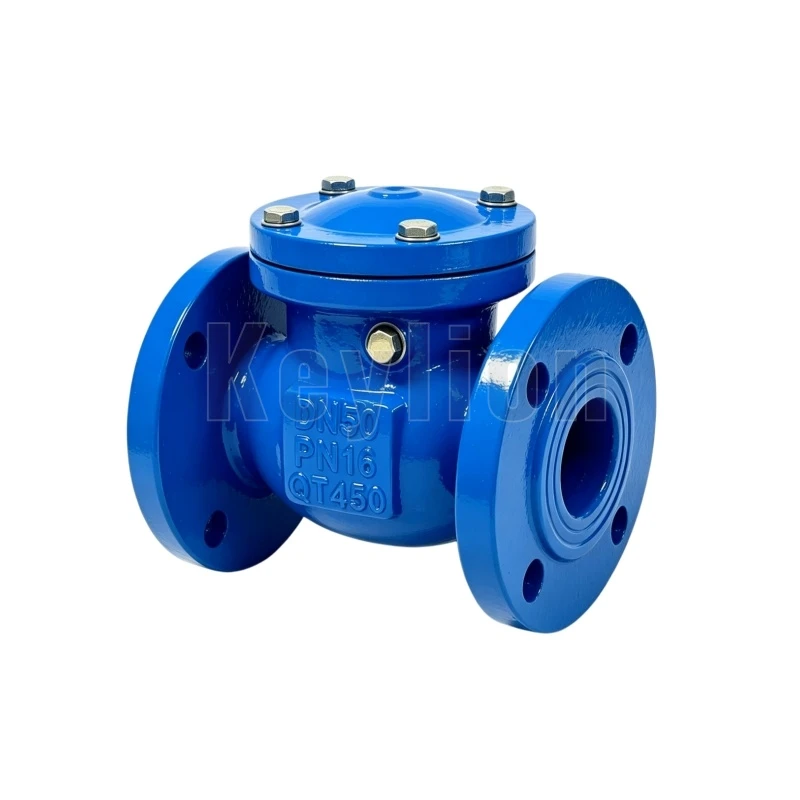

Last week, a regular client from the Philippines sent me a photo from his project site. They were installing a batch of our flanged swing check valves . He asked a question that we hear all the time: "Hey, can we just install these swing check valves vertically? Space is tight here."
It sounds like a simple "yes or no" thing, right? But if you get it wrong, you're looking at a loud "thud" every time the pump stops, or worse-backflow that destroys your expensive equipment.
So, let's talk real talk about swing check valve vertical installation.
Can swing check valve be installed vertically
The Short Answer: Yes, But Only One Way
To be honest, you can install a swing check valve in a vertical position. But-and this is a big "but"-the flow must be upward.
Why? It's all about gravity. A swing check valve works because a disc hangs on a hinge. When the water or oil flows forward, it pushes that disc open. When the flow stops, gravity and the weight of the water should pull that disc back down to seal the valve.
If you install it vertically with the flow going up, gravity helps the disc close. If you try to install it with the flow going down, gravity will actually hold the disc open. The valve becomes useless. It won't stop backflow at all.

Why Most Engineers Still Prefer Horizontal
Even though vertical (upward) works, if you walk onto any major industrial site, you'll mostly see swing check valves installed horizontally. Here's why:
Water Hammer: In a vertical pipe, when the flow stops, the disc has to travel further and fight the weight of the water column to close. This often causes a "slam" or water hammer. It's loud, and it vibrates the whole pipe.
Wear and Tear: In vertical lines, the hinge pin takes a lot more stress. I've seen valves where the hinge wears out twice as fast because of the constant vertical dragging.
Sealing Pressure: In a horizontal line, the disc sits naturally. It doesn't need much back-pressure to create a tight seal.
Practical Tips for Your Next Project
If you absolutely must go vertical because the pump room is too small, here are three things I always tell my customers:
Check the flow arrow
Every Keylion VALVE body has a cast-in arrow. Double-check it. Triple-check it. If that arrow points toward the ground in a vertical line, stop immediately.
Distance matters
Don't put the check valve right next to an elbow or the pump outlet. You need at least 5 to 10 times the pipe diameter of straight pipe before the valve. Turbulent water makes the disc "chatter," which leads to early failure.
Consider a Spring-Loaded Valve
If you're worried about water hammer in a tall vertical lift, sometimes a swing check isn't the best tool. A spring-assisted silent check valve might be a better fit, even if it costs a bit more.
If you are currently sourcing for a project and need the technical specs for ductile iron swing check valves, feel free to drop me a message. We've seen hundreds of these installations, and I'm happy to share what works and what doesn't.
Phone Number
+86 188 5956 1818
sales@keylionvalve.com