
Swing Check Valve Installation: A Guide to Ensure Performance and Longevity
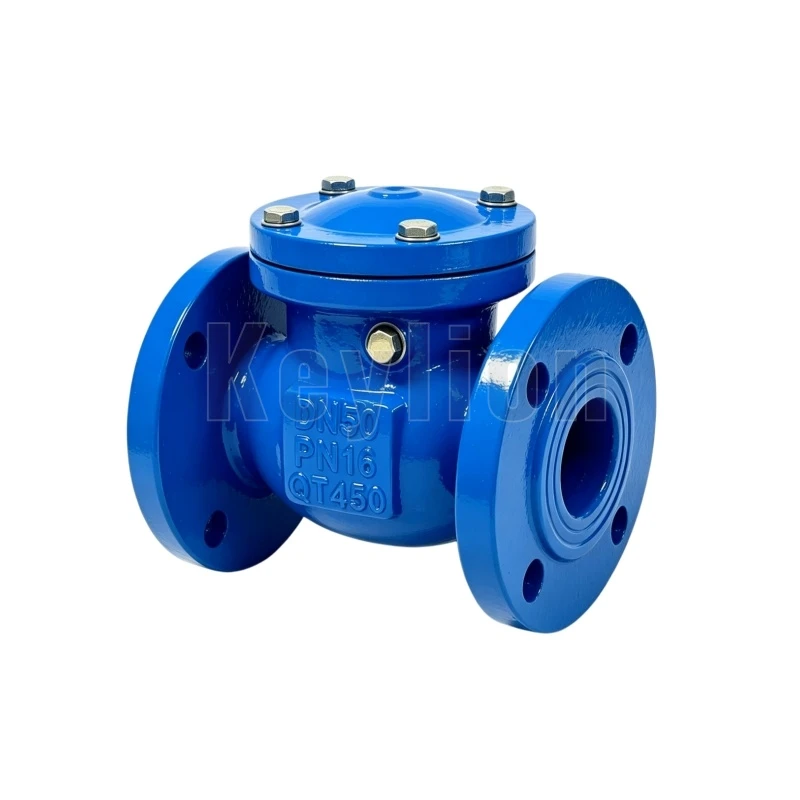
[The swing check valve] is a cornerstone of backflow prevention, but its effectiveness hinges entirely on one critical factor: correct installation. A valve installed improperly will, at best, underperform and, at worst, fail catastrophically, causing system damage. Adhering to industry standards and fundamental principles is not a recommendation-it is a requirement for safe, reliable operation. For ductile iron valves, compliance with standards like MSS SP-136 is paramount for ensuring mechanical integrity and installation consistency.
This guide outlines the key practices for a successful swing check valve installation.
1. The Golden Rule: Respect Flow Direction and Gravity
This is the most fundamental and non-negotiable rule for swing check valves.
● Flow Direction: Every swing check valve body has an arrow cast into it, indicating the design flow direction. The valve must be installed so that the desired forward flow enters the valve in the direction of this arrow. Installing it backwards renders it useless.
● Orientation: The swing disc inside the valve relies on gravity to swing closed when forward flow stops.
○ Horizontal Lines: This is the ideal and most common installation orientation. The valve can be installed in any horizontal run of pipe.
○ Vertical Lines: Installation in vertical lines is only permissible if the flow is upward. In this "vertical-up" configuration, the upward flow pushes the disc open, and gravity will pull it closed when flow stops. Installation in a vertical-down flow line is strictly forbidden, as gravity will hold the disc open, preventing it from sealing.

2. Location, Location, Location: Strategic Placement for Optimal Function
Where you place the valve in the system is crucial for its operation and system health.
● Downstream from the Source: The valve should always be installed downstream of the equipment it is protecting, such as on the discharge side of a pump.
● Provide a Straight Run: Install the valve with an adequate length of straight, unobstructed pipe upstream (typically 5-10 pipe diameters is recommended). This allows the flow to stabilize before entering the valve, preventing turbulent flow that can cause disc flutter, premature wear, and noisy operation.
● Access for Maintenance: While designed for minimal maintenance, ensure the valve is installed with reasonable access to the cover. This allows for future inspection, cleaning, or seat replacement if necessary without requiring full system disassembly.
3. Pre-Installation: Pipe and Environment Readiness
Proper preparation prevents poor performance.
● Pipe Alignment & Support: The connecting piping must be properly aligned and independently supported. Never use the valve to take up pipe misalignment or support the weight of the pipe. This places stress on the valve body (especially critical for ductile iron, which is strong but should not be subjected to undue bending forces) and can distort the seat, causing leaks.
● Clean the Pipeline: Before installation, thoroughly flush the pipeline to remove welding slag, dirt, scale, and other debris. Foreign material can lodge in the valve seat, preventing tight closure, or jam the hinge pin, causing mechanical failure.
● Consider the Environment: For installations in corrosive atmospheres or with certain fluids, ensure the valve material (e.g., ductile iron with suitable internal/epoxy coatings) is compatible. Standard uncoated ductile iron is not suitable for highly corrosive chemical service.
4. Common Installation Errors to Avoid
● Proximity to Flow Disturbances: Avoid installing the valve immediately after elbows, tees, reducers, or other control valves. The disturbed flow pattern will hinder proper disc operation.
● Ignoring the Arrow: The simplest and most common error is installing the valve backwards. Always double-check the flow arrow against your system's intended flow.
● Wrong Orientation in Vertical Lines: Attempting to install in a downward-flowing vertical pipe will guarantee failure.
● Insufficient Upstream Straight Run: This leads to turbulence, disc chatter, water hammer, and shortened valve life.
Conclusion: Installation as the Foundation of Reliability
A swing check valve is a precision, passive device. Its reliability is a direct result of its design, material quality-such as the strength and durability offered by ductile iron construction-and, most critically, its installation. By strictly following the principles of correct orientation, strategic placement, and proper piping practice, you ensure that the valve performs its vital role of preventing backflow silently and reliably for years, protecting your pumps and safeguarding the integrity of your entire piping system.