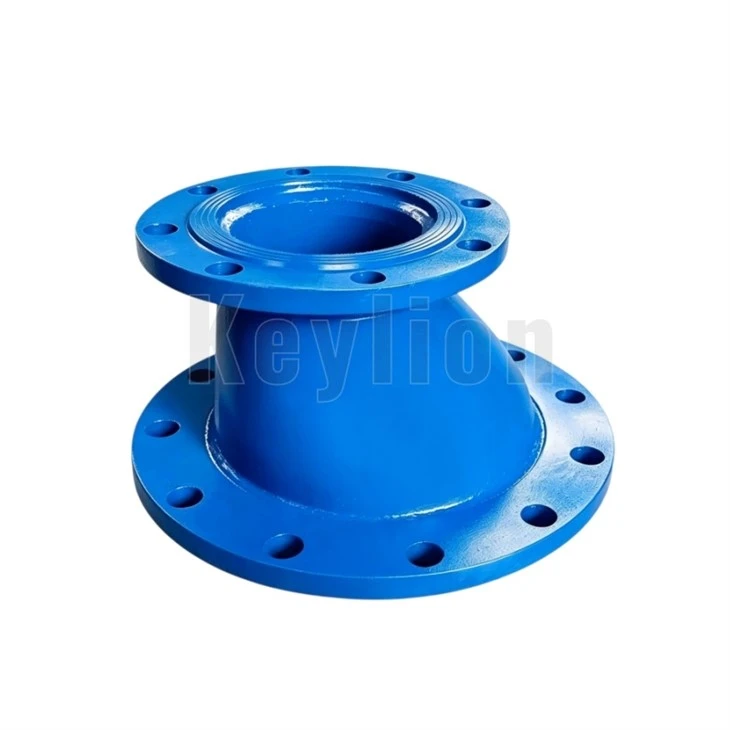
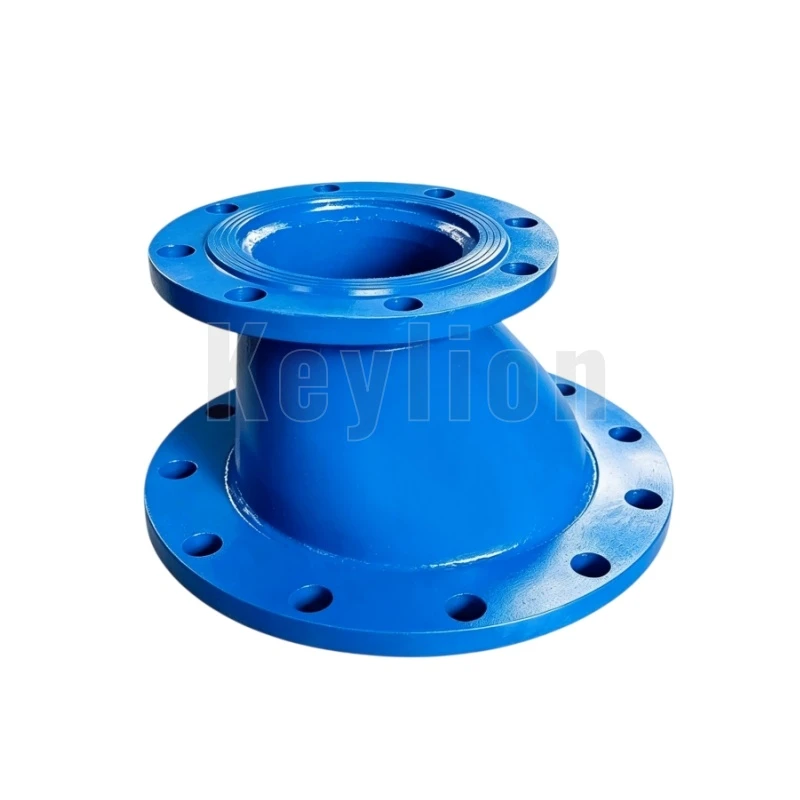
Flanged Eccentric Reducer
Keylion® flanged eccentric reducer - many site engineers and contractors also refer to it as flat-bottom reducer or eccentric taper.
This fitting connects pipes of different sizes and offsets the central fluid flow axis. For most industrial piping projects, it provides a smooth hydraulic transition and reduces pressure drop in the pipeline. Our customers frequently use it in pump stations, cooling water circuits and chemical processing lines.
One key benefit comes from its flat straight side: it removes trapped air bubbles on pump suction lines. It also supports proper fluid drainage on horizontal discharge piping. This simple design is very effective at preventing cavitation and unplanned site downtime.
Technical Parameter
| Product Name | Double Flanged Eccentric Reducer (Flanged Taper) |
| Brand | Keylion® |
| Type | Eccentric (One side flat, one side sloped) |
| Material | Ductile Iron |
| Nominal Pressure | PN10 / PN16 / PN25 / 200PSI / 300PSI |
| Flange Standard | ANSI/AWWA/GB/BS/DIN |
| Size Range | DN50 × DN40 up to DN1200 × DN1000 |
| Surface Coating | Fusion Bonded Epoxy (FBE) powder |
| Applicable Medium | Potable Water, Sewage, Wastewater, Neutral Liquids |
| Working Temperature | 0°C to 70°C |
FAQ
Q: Why do we choose eccentric reducers over concentric ones for pump suction piping?
A: The main reason is to prevent air pockets from forming inside the line. A concentric reducer creates a high point in the pipe where air gets trapped. This trapped air can lead to pump cavitation and cause costly damage to your pump unit. An eccentric reducer's flat profile maintains smooth flow and prevents air accumulation.
Q: When mounting an eccentric reducer on pump suction, should the flat side face up or down?
A: Most water supply projects use top-flat mounting, meaning the flat side faces upward. This setup prevents air from gathering at the top of the pipe. But this is not always the case. If your media contains heavy solids or slurry, or liquid flows upward from underneath, go for bottom-flat installation. This method stops sediment buildup inside the fitting.
Q: What makes ductile iron (DI) a better option than standard cast iron (CI) for these reducers?
A: Nodular graphite exists within the microstructure of ductile iron. Unlike brittle cast iron, ductile iron offers stronger tensile strength, greater impact resistance and good ductility. It can handle higher operating pressure and water hammer loads, so it is far less likely to crack under tough site conditions.
Hot Tags: flanged eccentric reducer, China flanged eccentric reducer manufacturers, suppliers, factory