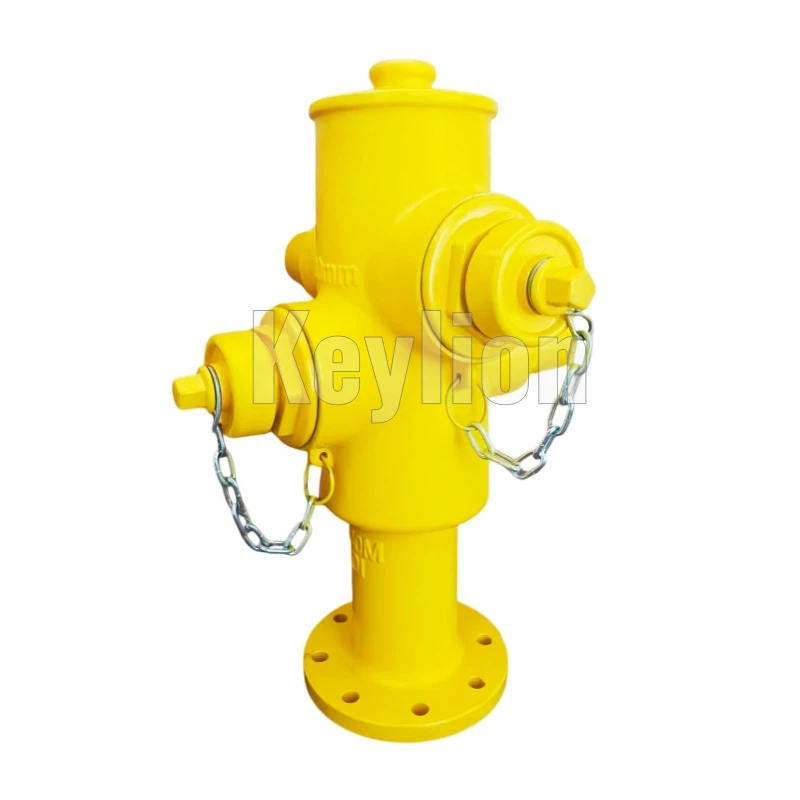


Fire Hydrant British Standard
If you are sourcing BS 750 fire hydrants, this two-way wet barrel pillar hydrant serves as a main water intake for municipal fire networks. It connects directly to pressurized underground pipelines to deliver rapid water supply for fire brigades.
Each outlet comes with an independent valve stem, allowing two hoses to run at the same time without interference. This model is widely seen on city roads, in industrial parks and high-risk commercial zones following British fire codes. Activating one outlet will not block the other; the spare port stays ready, making it ideal for fire projects requiring dual backup water supply.
Technical Parameters
| Parameter | Specification |
| Product Name | Fire Hydrant British Standard |
| Design Standard | BS 750 |
| Body Material | Ductile Iron (GGG50) / Cast Iron (GG25) |
| Valve Material | DI / Aluminum / Brass |
| Inlet Connection | 4" (DN100) or 6" (DN150) Flanged |
| Outlet Connection | 2 x 2.5" (DN65) |
| Working Pressure | 16 Bar |
| Surface Finish | Epoxy Powder Coating |
BS 750 two-way wet barrel pillar hydrant is typically used as a primary water intake in municipal fire distribution systems. It is installed at accessible roadside or site entry points and connected directly to pressurized underground mains.
We often see this model specified in British standard fire protection schemes. Common applications include city roads, industrial parks, logistics yards, and high-risk commercial developments. Because each outlet has its own valve stem, one can be used while the other remains on standby.
For fire brigade operations, dual outlets are a practical advantage. They allow more than one hose line to be connected at the same time, which can be important during peak emergency response or at larger facilities.
We normally remind buyers to review the project specification carefully. While this is a standard BS 750 solution, coastal exposure, heavy industrial corrosion, or local approval requirements may affect the final material and coating choice.


How to choose Landing Valve Material
The right material mainly depends on the installation environment and project budget, but corrosion resistance and local approval requirements also matter a lot. In coastal areas or highly corrosive sites, material choice can directly affect service life and maintenance frequency.
Brass is often preferred for coastal areas because it handles salt spray and humid conditions better. It is relatively durable, but higher material cost may push the project budget up. For some municipal or heavy-duty schemes, buyers may also consider ductile iron with protective coating, depending on site conditions and approval rules.
Ductile iron is a common choice for municipal use. It is cost-effective and mechanically strong, especially in standard urban environments. However, its corrosion performance depends heavily on the coating quality, so surface treatment should be checked carefully during inspection.
Aluminum alloy is a lightweight option and easier to handle during installation. It can be a practical choice for certain projects, though buyers should confirm whether it meets local fire standards and project specifications before selection.
FAQ
Q: Can I connect a 2.5-inch fire hose to a BS 750 pillar hydrant?
In most cases, yes, but the outlet size and coupling type must match. We often remind buyers to confirm the connection standard before placing the order, especially when hoses and hydrants come from different suppliers.
Q: What are the chain and blank cap used for?
The chain stops the cap from being lost when the outlet is open. The blank cap then protects the outlet from dirt, dust, rain, and tampering. For routine site management, this is more important than it may first appear.
Q: Why are there two outlets?
Two outlets give flexibility during emergency response. Firefighters can connect more than one hose, or use one outlet while keeping the other ready. This design is common on municipal and industrial fire networks where water access points need to be both practical and reliable.
Hot Tags: fire hydrant british standard, China fire hydrant british standard manufacturers, suppliers, factory, Red And Yellow Fire Hydrants, 2 way hydrant valve, Fire Hydrant Philippines, Fire Hydrant in The Philippines, pillar hydrant valve, fire hydrant water valve